Minnesota, of all places, has become the hottest market in the country for low-dose cannabis-derived THC drinks - and probably anywhere else, including Canada and Europe.
The unexpected success of these marijuana drinks could bode well for the state's nascent recreational marijuana market, with adult-use sales expected to begin in a little more than a year
On January 1, the possession, use and self-production of recreational marijuana became legal in the state.
Meanwhile, consumers from all walks of life are flocking to cannabis-derived THC drinks, where monthly sales can exceed $10,000.
Extensive retail access is fueling the boom, easing the stigma associated with marijuana and the state's geographic location on the map.
Illinois and Michigan are only a few hours away from most residents.
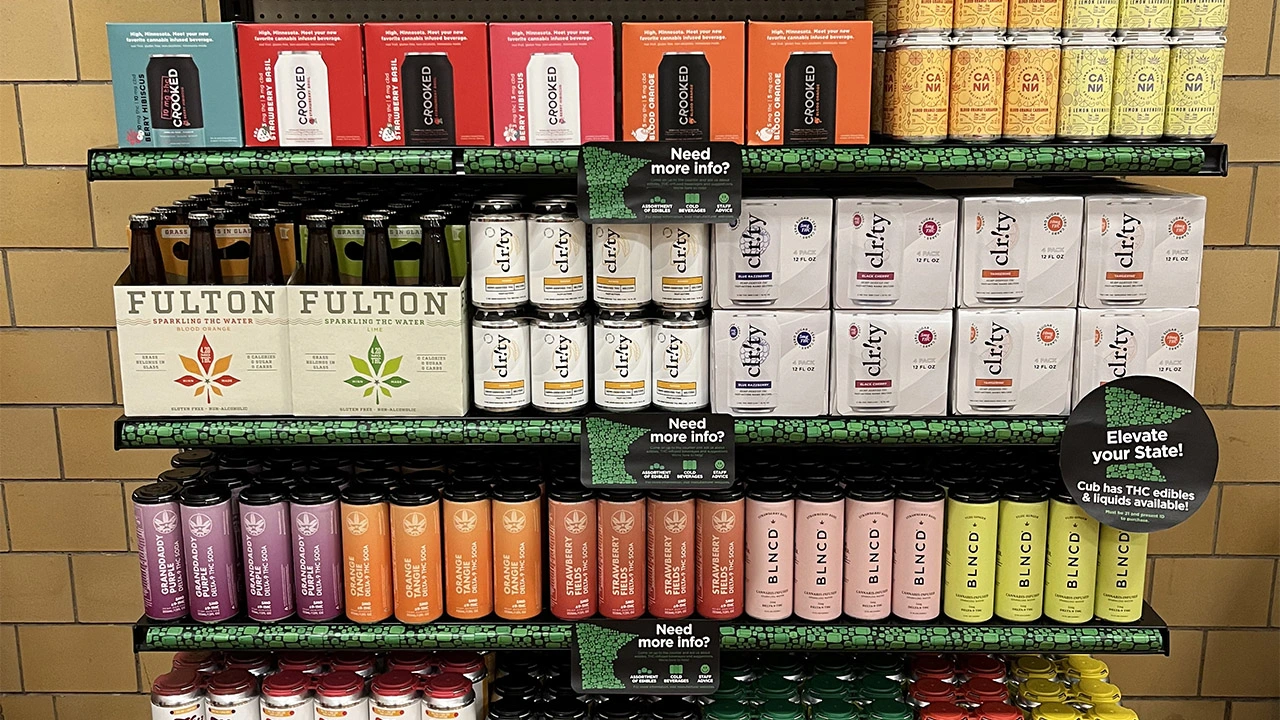
Minnesota regulators and lawmakers have paved the way for cannabis-derived THC to be sold in Midwestern markets, a big reason why these types of drinks are selling well in liquor stores, restaurants, grocery chains like Cub Supermarkets, and other places that are largely closed to THC products nationwide.
The 2018 Farm bill legalized marijuana and opened the door to the sale of delta-8, delta-9, and other intoxicating cannabinoids derived from marijuana with up to 0.3% THC by dry weight.
The Minnesota marketplace, which does not require a license to sell cannabis-derived THC products, kicked the door down.
Industry sources told MJBizDaily that the wide availability of low-dose THC products is also helping to attract new customers, especially non-smokers and baby boomers.
"It's getting consumers across the state to recognize that they can buy these products the same way they buy alcohol," said Leili Fatehi, partner and principal at Blunt Strategies, a Minneapolis-based government relations and communications firm that helped develop the state's marijuana legalization policy.
"The sky hasn't fallen yet. If anything, we're seeing consumers more prepared and comfortable to engage in conversations, learn about products, and approach them safely.
The beverage boom has also been a boon for local manufacturers - including one of the state's larger independent craft brewers, Minneapolis-based Surly Brewing Co. - as well as national marijuana brands such as California-based infused beverage maker Cann, One of several companies that ship cannabis-derived THC beverage products from Minnesota to consumers nationwide.
Paradigm shift
The foundation for Minnesota's current cannabis-derived THC drink boom was laid just over a year ago, in the month of 2022.
That's when state lawmakers passed a groundbreaking law allowing the sale of marijuana-derived THC foods in mainstream retail outlets like grocery and convenience stores - recreational and medical marijuana markets that are essentially off-limits to distribution channels.
"We've seen an absolute explosion of the THC beverage market in Minnesota almost overnight," said Jason Tarasek, a marijuana attorney with Vicente Minneapolis.
"I wouldn't say it's completely integrated into our culture and society, but it's come along the way.
According to the law of the Year (>) that came into force on 1 December 2022:
Foods must contain 5 milligrams or less of cannabis-derived THC per serving, or a maximum of 50 milligrams per pack.
Drinks must contain 5 milligrams or less of cannabis-derived THC per serving, or a maximum of 10 milligrams per pack.
Insiders say the prolonged heat could signal a strong adult-use market, which could bring more restrictions similar to those in other recreational marijuana states.
Minnesota became the 23rd U.S. state to legalize adult use of marijuana, after Governor Tim Walz signed a unique legalization bill last August that also allows the sale of cannabinoids derived from marijuana, such as delta-<> THC.
The law legalizing adult use could bring changes to the cannabis-derived THC market in Minnesota - changes that could affect sales.
"The Adult Use of Marijuana bill would impose stricter regulatory and licensing requirements on these cannabis-derived THC products," Tarasek added.
"We may start off fairly light on regulation, but we'll tighten it."
Sources told MJBizDaily that retail in the adult market is expected to start in early 2025.
By comparison, according to the 110 MJBiz Factbook, the state's medical marijuana retailers are expected to generate $23,2028 million this year, growing to $<>.<> million by the end of 2023.
Brewing opportunity
In crafting the 2022 legislation that sparked the low-dose THC frenzy, Minnesota lawmakers and industry stakeholders prioritized local business opportunities and homegrown supply chains, according to Fatehi.
"We made a tremendous effort to pass a law that created this business-focused Minnesota marketplace," she said.
As a result, national brands have been looking for Minnesota manufacturers.
For example, California-based Cheech&Chong's Cannabis Co. With two Minnesota-based craft brewers, Surly and Duluth-based Bent Paddle Brewing Co. Collaborating to produce the celebrity brand's expanding line of low-dose THC beverages.
"About 90 percent of the products sold in Minnesota are grown and manufactured within the state," Brooke Mangum, chief marketing officer at Cheech&Chong, told MJBizDaily.
"We are proud to support local businesses.
Los Angeles-based Cann, one of the best-selling makers of low-dose THC beverages in the U.S., is partnering with Minneapolis-based Fair State Brewing Cooperative to expand direct sales and wholesale distribution to 33 states.
"Because Minnesota's law allows cannabis-derived delta-9 beverages to flow freely across the country, more than half of our revenue comes from non-marijuana dispensary channels," said Cann co-founder Luke Anderson.
"This is the manufacturing center where our products are sold all over the country.
Even the state's homegrown grocery chain Cub - better known as Cub Foods - is getting into the act.
"In accordance with Minnesota law, and without conflict with local ordinances, Cub Foods has begun selling foods and beverages containing low doses of THC in the company's liquor stores," Charles Davis, a spokesman for parent company United Natural Foods, confirmed.
Cub, based in Stillwater, operates about 80 supermarkets and pharmacies primarily in the Twin Cities area.
Getting a good economic read on this emerging product category is a challenge, with sales figures and growth forecasts scarce.
Headset, a Seattle-based provider of cannabis analytics, told MJBizDaily that it does not track cannabis-derived THC sales in the Minnesota market.
The 11-year National Cannabis Report released in 2023 valued the production of Minnesota-grown floral cannabis at <> $10,000.
But this does not take into account cannabis-derived products, which would significantly increase this estimate.
The opt-out dilemma
While low-dose THC products are widely available to consumers statewide, dozens of cities and counties have enacted measures to impede commercial operations.
From California to New York, municipal opt-outs of commercial marijuana and marijuana schemes are all too common.
These bans undermine the true potential of the market and can have a chilling effect.
"Cub does not sell low-dose THC products in places that are prohibited by local municipal ordinances," Davis told MJBizDaily without prompting.
According to statistics from the Center for Public Health Law at the Mitchell Hamlin School of Law in St. Paul:
Eighty cities and five counties in Minnesota have passed suspensions related to the sale, testing, manufacturing or distribution of THC products.
Forty-two cities and two counties have adopted licensing and sales restrictions.
"These suspensions are very problematic because they're not actually based on any good public policy considerations," Fatahi said.
"They seem to be a reflection of concern about something new.
Long game
Legalizing and regulating CBD and low-dose THC products is a bit backwards in the market for developing recreational marijuana programs.
Other adult-use states, such as Nevada, New York, and Vermont, have enacted product bans and other restrictions related to delta-8 products.
But some Minnesota policymakers have a longer view.
According to Fatehi, they want to develop a new class of local entrepreneurs who can create their own unique retail operations, business plans, and supply chains while enjoying certain federal protections and benefits associated with banking, loans, and capital.
"Operating in cannabis-derived Spaces is one of the best entrances to transitioning to operating in adult-use Spaces and setting yourself up for success," she said.
"It makes them more competitive when it comes to applying, because now they have a good track record."
It looks like these early entrants have room to run, too.
"There's a lot of pent-up demand for cannabis products in Minnesota," Tarasek said.
"It's the only game in town."